
News

Get Out of Your Own Way
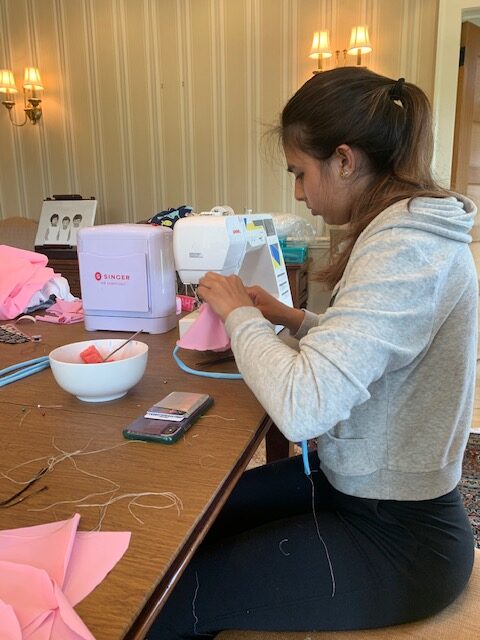
I learned to get out of my own way from my daughter. At age 17, she started her own company, Celia Swimwear.

My husband and I didn’t even know she had done this until she needed our, over 18 adults, help to establish her LLC and open bank accounts. She has always been a visual artist and a seamstress since she was little. She designed her own swimsuits and tried sewing them. She realized that sewing swimsuits were difficult, the material, the stitching, etc. That did not stop her. She found a manufacturer who would produce her designs and who shared her values. She set up an online shop and got to work. Her sales were not taking off on her first line. That did not stop her. She learned about advertising on social media. She was hit with a large and unexpected customs bill. That was a big one!

Start Small to Make Big Change

In the last few years, my son has become an avid climber. He loves to scale the indoor climbing walls as well as make his way up to some actual mountains. Of course, I found this terrifying as his mother. One look at the heights and steep climbs and I was scared. He took me once to an indoor climbing gym and I watched as he took one small part of the wall at a time, sometimes trying the same foothold and spot multiple times. I found this to be an intriguing and valuable lesson. One mistake I often make in my life is that when I want to make a change, I start with a BIG idea or vision and leap in with lots of energy trying to get directly to my end goal. As I watched my son practicing securing each foothold, I realized that he was teaching me something important.

Balancing Effort and Ease

Balancing effort and ease is one of the paradoxes in leadership and in life. I first heard this phrase in yoga class. Recently, I have developed a yoga routine that has been helpful for me not only in terms of my body but also my mind and spirit. I often feel that the things I learn from my yoga teachers are applicable to life and leadership. This lesson of balancing effort and ease is one of many I am currently learning. 

Balancing effort and ease is one of the phrases that the teachers often mention when holding a difficult position or trying a new pose. As my teacher explained, the challenge should be enough to be interesting and require a certain amount of effort and still, you should be able to breathe and have an awareness of what is happening. When we find the middle path, we find success.

How can you have both effort and ease?

Self Care is Not Selfish

Self-care is not selfish. Growing up I learned a different message. As a child in an immigrant family, I was raised watching parents who worked tirelessly for the good of others, building and supporting our small but growing Sri Lankan community in New Jersey. My parents did not take time for haircuts, manicures, exercise, or even an indulgent moment with a hot cup of tea and a good movie was rare. When I was a young mom and teaching full time, the last thing I spent time and resources on was self-care. I hustled to do my best at my job and take care of my family. I did indulge in the occasional haircut, soaking in every moment of the luxurious hair wash and scalp massage. Although when I returned home, I worked extra hard to cook, clean, and spend time with my kids. I almost felt guilty for getting a haircut, for taking care of myself, and for having time alone.

Intention or Intuition?

Which is more helpful when making decisions, using your intuition, or grounding yourself in your intention? Let’s define intuition as your ‘gut’ feelings, which are usually based on your past experiences and personal values. Let’s define intention as your grounded purpose or mission. I believe intention can also have its roots in what you value. Which strategy do you use when making decisions, intuition or intention? Do you lean on your experiences and your gut feelings when making a decision? Do you ground yourself in your original purpose and mission when making a critical decision? For example, when it comes to hiring in schools, we often decide to go with our ‘gut‘ feelings about a candidate: intuition. Yet, when we take the time to have an intentional process that honors the mission and values of the school and takes into account possible biases, and includes multiple voices, we may find ourselves with the right candidate for the position. 

Your Words Matter: Think Before You Talk

As a young child, my father had a phrase, I might even say it was a mantra, that he often communicated to my sisters and to me, ‘Think before you talk.” Even as I type it out now, I feel the eye roll of an adolescent child begin to take over. As a young female in a South Asian immigrant family, I interpreted this phrase as ‘be quiet’ or ‘speak when spoken to’ and I did just that. I was an introverted, quiet child who spoke rarely in the school setting. I often kept a long and winding inner narrative alive in my head but rarely shared my thoughts with others. I did not think my words mattered to others. Now as many years have passed, I actually find myself thinking of this phrase with new meaning.

As an adult, a leader, an educator, and a parent I have learned through many small and big moments that this was not the full interpretation of the phrase.

What’s Behind the Behavior?

When I was teaching, each child in the classroom acted differently. Their behaviors were a way of communicating: of sharing thoughts, feelings, and needs that were maybe not being met. As leaders, we can look at our teams similarly to how children act in classrooms. Look closely at your team and think of their behaviors. A close exploration of their actions can help you understand their beliefs and so much more. Elena Aguilar talks about transformational coaching and the 3B’s, behaviors, beliefs, and being. She talks about behaviors (instructional practices and skills) leading to effective practice, exploring the beliefs (about teaching, learning, children, and families) that you operate from, and ways of being, “the ways in which our sense of self and identity impact our experience”. What is your team telling you, both as individuals and as a group through their behaviors? 

Questions to ask as you observe your team:

  • What is the need behind their behavior?

How Deep is Your Bench?

How deep is your bench? 

I am usually the last person to use a sports metaphor but it actually works well here. To have a deep bench means to have a significant number of effective people on your team. This is something you should evaluate intentionally and periodically. 

Having a strong team ensures better collaboration, decision-making, problem-solving, and ultimately better results. When you don’t have a strong team, you may find yourself trying to put out fires that others should be handling, not using your time effectively. 

First, evaluate your bench, your team.

These are some possible indicators that your bench needs some strengthening, 

  • Are you taking on too many tasks yourself?
  • Do you find your team members need your input on every decision they make?
  • Are you attending lots of meetings that you may not need to attend?
  • Do you have to be always present for efficient and effective work to be accomplished?

Modeling Leadership Style

What kind of leadership style are you modeling in your family? 

I grew up in a first-generation immigrant family. My father worked 6 days a week as a physician at a hospital, a clinic, and also running his own practice. He left early in the morning and returned late at night. The only day he was home was Sunday. On Sundays, he worked too but on home-related things: mowing the lawn, weeding the garden, changing the oil in the car. He was a hard worker who was dedicated to his profession and to his patients and was determined to create a certain life in a new country for his family. What did I learn from watching him? I learned to work hard all the time. I learned that you can achieve what you set out to with determination. I learned that it was important to do things yourself. I also learned difficult things, some of which I have had to unlearn.

What’s in a Name?

What’s in a name? When I was growing up, I can’t tell you the number of times people either mispronounced my name or just didn’t say it at all. In ninth grade, I switched schools and somehow a classmate assigned me a shortened version of my name. It stuck. This made life infinitely easier. As time went by, I felt a loss for my full given name. Who was I making it easier for? Me or others? I realized I was just trying to avoid microaggressions and awkward, challenging moments that others created because they couldn’t be bothered to take the time and effort to attempt an unfamiliar name.

Names are a big part of a person’s identity and probably one of the first things that you learn about a person. It’s natural to sometimes mispronounce an unfamiliar name. Most of the time, there are no bad intentions involved. Still, the impact of mispronouncing a name, not taking the time to learn the correct pronunciation, or using ‘nicknames’ can be harmful.