
Tag: change management

Exit Interviews

Gathering data from your exiting employees is crucial. Photo by Andrew Teoh on Unsplash

Exit interviews are vital to the growth of your institution and an important part of saying goodbye. Are you doing them? Are you doing them well? Exit interviews are one on one meetings conducted when an employee moves on from your institution. When done well, they are great sources of data. 

Some places may have an HR member discuss benefits with an exiting employee and call that an exit interview. In other places, just let that employee walk away and gather no data at all about their experience. Don’t let this opportunity for growth pass you by. Stop and think about what you can learn from this individual and their experience no matter what reason or what conditions they are leaving under. Another invaluable benefit of conducting exit interviews is that you are providing the exiting employee the opportunity to vent in a safe and productive manner. 

Saying Goodbye

It’s that time of year again in schools, a time for saying goodbye.

Photo by Ioana Cristiana on Unsplash

May and June are filled with transitions: graduations, retirements, faculty and staff movement, and more. The way a community manages transitions matters and reflects upon that community’s mission, vision, and values. How do you say goodbye and why is it important?

“The way we gather matters.” states Priya Parker, the author of The Art of Gathering, How We Meet and Why It Matters. She defines gathering as “the conscious bringing together of people for a reason.” Priya Parker goes on to say that when we gather together, we “exchange information, inspire one another, test out new ways of being together” to name a few outcomes. Nonetheless, we spend very little time intentionally planning and thinking about the ways we gather. 

Gathering to say goodbye is the bringing together of people to honor a person or people as they move on.

Leading with Equanimity

Leading with equanimity can lead to a spacious mind. A February morning in New Jersey.

Do you lead with equanimity? What does equanimity mean to you? When I first heard the phrase ‘lead with equanimity’, I would imagine someone who was standing still in the middle of chaos, someone who did not waver or show emotion, someone who did not react and was ultimately possibly ineffective. To me, this is no longer a true or complete version of leading with equanimity. 

My Early Thoughts

When I first started my journey into leadership, I found that I became easily tightly attached to an idea or plan. I had thought long and hard about how the plan was going to work and stuck to it. Sometimes, I was so attached to the plan or idea that I could not see some pitfalls, unintended consequences, alternative ways to proceed, or necessary course changes. Other times, I found myself so averse to an idea or plan that I could not possibly see a way for it to work.

Get Out of Your Own Way

I learned to get out of my own way from my daughter. At age 17, she started her own company, Celia Swimwear.

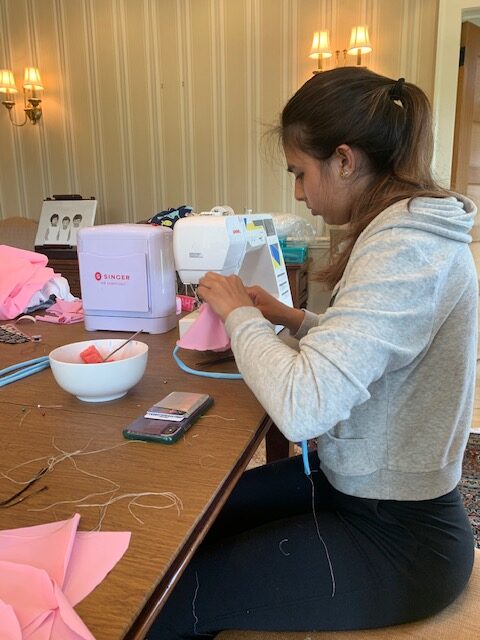
My husband and I didn’t even know she had done this until she needed our, over 18 adults, help to establish her LLC and open bank accounts. She has always been a visual artist and a seamstress since she was little. She designed her own swimsuits and tried sewing them. She realized that sewing swimsuits were difficult, the material, the stitching, etc. That did not stop her. She found a manufacturer who would produce her designs and who shared her values. She set up an online shop and got to work. Her sales were not taking off on her first line. That did not stop her. She learned about advertising on social media. She was hit with a large and unexpected customs bill. That was a big one!

Start Small to Make Big Change

In the last few years, my son has become an avid climber. He loves to scale the indoor climbing walls as well as make his way up to some actual mountains. Of course, I found this terrifying as his mother. One look at the heights and steep climbs and I was scared. He took me once to an indoor climbing gym and I watched as he took one small part of the wall at a time, sometimes trying the same foothold and spot multiple times. I found this to be an intriguing and valuable lesson. One mistake I often make in my life is that when I want to make a change, I start with a BIG idea or vision and leap in with lots of energy trying to get directly to my end goal. As I watched my son practicing securing each foothold, I realized that he was teaching me something important.

Traditions

Traditions usually uphold our history and are connected to strong memories. They help us remember people, places, and events and have the opportunity to give us a sense of belonging and community. Traditions are familiar and can bring comfort, pointing to the passing of time. 

In schools, we have many traditions at this time of year: moving up ceremonies, graduations, retirements, and more. We celebrate the successes of our students, faculty, and staff while engaging in traditions and rituals to show the passing of time. This is yet another time of transition.

Should traditions change as our communities change? Many of our schools don’t look the way they did at their founding. This is a good thing. Change is essential. Sometimes there are opportunities to bring new life to long-standing traditions in a way that honors the past as well as acknowledges the present. How do we do this? We begin with reflection as these are big decisions.

Hope is a Plan!

Conventional wisdom says that hope is not a plan. I disagree. Hope is most definitely a plan. Cultivating hope is a skill that we need to practice and develop, and hope is especially needed when facing hardship. This is a time globally, locally, and in our workplaces of crisis. Hope has agency and purpose. It encourages a perspective that can help us see possibilities and choices. Hope, as a skill modeled by leadership, can lead to increased engagement and better health.

Look at the data and imagine an outcome. The data holds us in realism and the imagining helps us think broadly and deeply about ‘what if’. You have to see some evidence in your world to imagine the possibility. Dr. Jacqueline Mattis, a clinical psychologist from Rutgers University, encourages us to ‘read the room’ and read the past, putting the pieces together to make reasonable expectations in her conversation with Dan Harris on Ten Percent Happier.

Making Resolutions or Setting Intentions?

The tragic events at the Capitol building in Washington D.C. further highlighted the rampant racism, injustices, and inequities that have plagued this nation. There are few moments in school leadership where there is absolute clarity of right and wrong. Now is the time to take a close look at who you are, your values, your aspirations, your hopes, dreams, and intentions. What you do and what you say matters and should be grounded in an understanding of our human interconnectedness. 

Every new year, we try in our personal and professional lives to start anew, making resolutions and promises to ourselves about how we will be different and who we will become. We make exercise and diet goals. We promise to spend more time with loved ones and be more productive and efficient at work. By February, we tire out and have dropped all resolve to accomplish our new tasks. What if instead of creating these long to-do lists each new year, we think of our intentions and start from there? 

Making Decisions, Decisions, Decisions

Making decisions as a leader can be complicated. Sometimes, we try to make everyone happy. Other times, we feel constrained by time and other factors, making a decision in a vacuum. Although these are unprecedented times, decision making is a constant in all organizations and especially crucial in organizations that involve children and families. Setting intentions, establishing goals, considering equity and inclusion issues, bringing in other voices, and reflecting are all crucial elements of a strong decision-making process. 

Below are some questions to consider as you navigate this year of constant and fast-paced decision making.

  • How do I identify the decision that needs to be made?
  • Have I established my intentions and referred back to my intention as I make this decision? Your intentions may be: holding the child at the center of the work and upholding the mission of the organization.
  • What are my year-long goals and how do I align with them?